Tuesday, 13 May 2014
Murder Takes a Dare - The Second Marisa Adair Mystery by Jada Ryker

Tuesday, 6 May 2014
A Hero for Hire by CB Pratt - A Review

Eno
the Thracian is a hero for hire in a world where legends are bred. He is the
perfect male, handsome, dashing, brave and forthright with an entertaining hint
of humour. This novel was an incredibly good read and I thoroughly enjoyed it.
I honestly couldn’t have predicted the ending at any point in the story. I
loved how the ancients are mixed in with the presence of the mystical, ghosts,
sphinxes and hags all decorate a novel with the power to hold the reader’s
attention with ease. All this without forgetting the company of a camel named
‘Nightmare’.
The
author clearly has a dry wit, which reaches out of the pages of the book and
makes the reader smile, continually. I would genuinely recommend this book to
anyone wanting a great read. This series would make an amazing movie serial.
 |
| C.B. Pratt Author of the Eno the Thracian Series |
C.B. Pratt has lived all over the United
States, including California, New York and many stops in between. Having been a
professional writer for over twenty years, she is ill-suited to any normal work
and hopes to continue writing for the rest of her life. Independent publishing
has allowed her to write the things she has always wanted to, including fantasy
and steampunk. She is the author of numerous traditionally published books, as
well as the Eno the Thracian fantasy-adventure series. RIVERS OF SAND will be
released late summer, 2014.
Sample or purchase Book 1 in the series: http://www.amazon.com/Hero-Hire-Eno-Thracian-ebook/dp/B00D6KPC1S/ref=sr_1_1?s=books&ie=UTF8&qid=1370385145&sr=1-1&keywords=c.b.+pratt
Web site:http://www.cynthiapratt.com/
Sunday, 4 May 2014
You might not 'realiSe' that it's time to 'apologiSe'.
I’ve
come across this issue a number of times now, so thought I would raise it.
Although I currently live in New Zealand, I was raised in England and West
Germany and did my English degree in Wales. Throughout my education, I was
taught what was loosely termed ‘Queen’s English’ which involved much more use
of the letter ‘s’ than ‘z’.
In
the years before I began publishing, I would happily read everything that I
could get my hands on. Yes, reading books by American authors was at first
strange, the prolific use of ‘z’ was initially jarring to the eye - realize instead of realise, but it wasn’t difficult to put these anomalies to one side
in favour of the general enjoyment of the novel. I love the colloquialisms
which inherently creep into a story through the author’s hands because the
writer is after all, a huge part of the evolution of the plot, characters and
the very atmosphere which enfolds the reader. A quaint turn of phrase can
indicate to an astute reader where the author hails from, how they feel personally
about a particular issue and what kinds of experience prompted certain parts of
the plot. Those are the very things that readers pick up on and head straight
for when they meet you and often, your input as the author is what drives them
to read more as they revel in your story and try to understand you.
The
first time I came up against the dreaded ‘s’ versus ‘z’ war, was when I began
doing paid reviews for an international review company. They complimented me on my
first review for them, but alluded to the editing
issues. Now everyone lets one drop occasionally. It doesn’t matter how many
times I proofread my own work, something still slips through. So I asked for a
list of what exactly was wrong and up it popped. I had used the word
‘apologise’ and it needed to be corrected to ‘apologize’. There were a few more
‘errors’ including ‘realise’, and it was quickly obvious that the relationship
was not going to survive the distance between our understanding of grammar
rules.
To
their credit, the company actually emailed me back, acknowledged that they were
an international company accepting novels from all over the globe and having an
English woman on the team was probably a good thing. I still write for them and
they humour me. Or do they humor me?
The
next time it happened was when I wrote a blog for someone. They thought it was
great, again, but for the editing. They altered it for me and I was surprised
at the sense of mortification I experienced. The English language originates
from my homeland of England. I don’t have a problem with the fact that it has
evolved and changed in its lifetime, or that other nations have borrowed it and
changed it. But I began to feel like my beautiful, archaic, expressive tongue
was being cauterised and thrown out.
 It
raised its head again when I published Artefact, as it was originally titled. The
wonderful author who gave her time to help me release it, debated back and
forth with me about whether it was artefact
or artifact. The book was set in
England I argued, and we spell it artefact.
But, she replied, you publish in the American market and we spell it artifact. I relented and changed it and
haven’t regretted it. The novel sells really well in Amazon.com and readers
seem to love it. In addition to that, she made me a gorgeous cover and gave me
lots of fantastic help. Who could argue with that?
 But
as for changing the way I write, wouldn’t that be a bit like trying to fake a
foreign accent, whilst not being particularly comfortable with it? It’s just
not me so why would I do it? I like the way that Her Majesty speaks and I can
guarantee that if I could grab a peek at her Christmas Day speech, she would
have used realise and apologise and there wouldn’t be a ‘z’ in
sight!
Being
a UK English writer, without the added fact that I don’t reside in England, I
am in a relative minority compared to the vast offerings from the US continent.
But the English language itself isn’t quite as small fry as US editors and
publishing companies would try and have me believe. I wish I knew the
statistics of the ratio of realise to
realize users, because then I could
do a pretty graph and look intelligent on the subject. I know English writers
raised in the huge continent of Africa, who spell words like me and to the best
of my knowledge, definitely New Zealand and possibly Australian schools teach UK
English. That's a fair hunk of land mass that agrees with moi.
To
have a crack at my cultural heritage, which yes, my spelling of certain words
is part of, is akin to me walking up to a Maori and telling them that their
spelling of the word for family - whanau
- is actually a bit rubbish. Not only would it be rude and disrespectful, it
would undoubtedly upset them and I would be in big trouble.
So
why shouldn’t I get defensive and upset, when beaten with the broad stick which
shouts, ‘Let’s all be the same - my
same, not yours?’ Just because I don’t spell something the same as you, doesn’t
make me wrong, but if we want to play the ‘etched on the face of history game’,
then I will win hands down. Realise has been around a damn sight longer than
realize, I’ll have you know!
I
guess the long and short of it is this: judge my work, judge my skill as an
author and feel free to review my books. But at no point does that give anyone
the right to disrespect the greatest representative of my cultural heritage -
my language.
It’s mine. I love it. So back off!

Saturday, 3 May 2014
The Forest Bull by Terry Maggert - A Review

A Spellbinding Novel that I just couldn't put down.
I listened to an audio version of this novel
and found it very hard to switch off. I felt as though I was dropped instantly
into the action, scrambling to keep up with the strong male patriarch of the
strange little family, as he went about his killing occupation. It was gripping
and at times, so graphically explained that it felt real and made me fearful of
actual monsters disguised as humans, who could potentially jump out at me. I
was powerless to second guess the plot or the direction of the storyline, led
like a lamb to the slaughter at every turn, forced to go around corners where
surprises would jump out at me without warning. The descriptive elements are so
strong that the reader is there, in the centre of the action, smelling the aromas,
hearing the sounds and experiencing everything that the writer is conveying.
It’s a masterpiece which utterly took me by surprise, not because I wasn’t
expecting it, because a reader always hopes, but because it wouldn’t be out of
place on a lofty shelf with Edgar Allan Poe. I felt desperate when I got to the
end of the novel, because it isn’t completely resolved and I will have to buy
the next one. If I could give it ten stars, I most certainly would!
Saturday, 26 April 2014
What? You actually want my opinion?


I’ve
spent my whole life reading. I have memories of living in West Germany as a
little girl, where my father was stationed with the Air Force and the library
on the air base was better than a sweet shop for me. We had no TV and our
entertainment was the British Forces Broadcasting Service radio programmes, Barbie
dolls (dangerous with a little sister who had a penchant for snapping off arms,
legs and occasionally heads) and books.
Books
were expensive even back in the 1970’s and the likelihood of getting something
written in English where the national language was German, was remote. But the
library on the base had them all lined up neatly on shelves, Enid Blyton, Roald
Dahl, my heroes, wearing dustcovers and little plastic jackets to protect
them from our tiny, eager hands. We went there on a Sunday after church but we
had to be quick as the lunch would already be in the oven - my organised
parents put it there before we left. There was no time to do proper choosing,
it was just smash and grab, child style. It was the highlight of the week for
me and sadly not always guaranteed. If Dad was on nights or working Sundays, we
didn’t get to go anywhere as Mum couldn’t drive.
I
remember once, getting home, scoffing my lunch and devouring Enid Blyton’s
‘Castle of Adventure’ for pudding. I couldn’t get enough of it. My mother
refused to believe that I had actually read it all in that short space of time,
coming upon me as I closed the back cover in sadness about two hours after
lunch. I recounted the whole thing and she was probably sorry that she had
asked, when I finally finished following her around the house four hours later.
But
what is my point here?
Well
it’s basically that back then, nobody really cared if I liked the book and went
back for the next one at the earliest opportunity. The publisher didn’t, the
library just had it there and the author would never have known that she just
make a little girl’s boring Sunday afternoon a whole lot better.

I
started publishing a year ago, but only got my Kindle six months later as a
gift from my mother. Up until then, I was still feeding my library habit, only
I could choose six instead of one and didn’t have to pay my younger sister in
household chores just to let me have her choose as well. Again, the library
didn’t care if I liked my picks when I returned them, they probably measured
their stats on how many times that book was issued, but they never actually
asked ME personally if I had enjoyed it.
I
always read the bit about the author in the back and love it when there’s a
photo because I can see if they look how I imagined them. Maybe there were
email addresses and website addresses but I had a book in my hands, not a
computer and so I don’t recall ever looking anything up.
The
world is different now. When I finish a book on my Kindle, a box pops up asking
me if I want to give it a star rating. Amazon emails me if I ignore that and
asks me what I thought of my purchase. As a reader, I’m bombarded by questions and
asked for my opinion about somebody else’s work. It’s no longer that detached
experience, it’s an interaction with a real person, who is going to see what I
think and have an opinion on it. As a reader, I’m not sure how I feel about
that. I like what I like and surely that’s nobody’s business but mine. Isn’t it?
As
an author, I am ranked and rated and statistically examined a million times
over, based on the reviews I get for my work. Some authors give away copies of
their precious works in return for reviews which they may never get, knowing that the greasy pole which our books have to
climb is aided by the solid opinion of our readers. Others cajole, encourage
and resort to begging readers who perhaps agree cagily and then don’t, for a
whole variety of reasons.
What
seems to have happened in the last few years, is that readers who willingly and
genuinely place reviews for every book they read, become hot property. Amazon
and Goodreads both have lists of their ‘top 100 reviewers’. I do routinely
review almost every book that I read nowadays, because I know that it’s
important and even I have a rank as a
reviewer - not a very good one yet, but it’s getting there. Authors used to be
powerful people, able to influence the fabric of society, the perception of
governments and the mood of the people. Now it’s readers.
With
the click of the keyboard, a reader can place a review that either devastates
or delivers hope to somebody who has put their work out there in the ether.
There are no surprises (other than perhaps content) as the author will be
eagerly awaiting that opinion. Some authors must check hourly for reviews. I’ve
put up a review as a reader, only to get a notification from Amazon within
minutes that ‘somebody’ liked my review and found it ‘helpful’. I know it’s the
author, who else could it be? I’m going to time the next one and see how long
it takes. I might even keep a book on it, in a light hearted, completely
non-financially advantageous way, you understand.
A
few reviewers really do understand the power of reviews. I have heard awful
stories of reviewers deliberately trashing work which they haven’t even read,
just because they can. They spend an afternoon dolling out one star reviews to
random authors because it’s raining and they were bored. But I wonder if they
get and keep that power, because not enough of the other readers out there,
know that their opinion is wanted and valued, very much. Perhaps if the load
was spread among the other millions, the corrosive influence of the few would
be dispersed.
I’m
not really sure what the answer is - I’m just musing as always.
I
guess what I’m saying is that, if you are reading this and currently
enjoying something on your iPad, Kindle or other device, just know that there
is an author on the other side of that creation who is desperate to know what
you thought. Yes you! They care about
how your received their main character, what you liked or didn’t about the
setting. Are you bothered that they killed off the lead actress at the end or
did you hate her anyway? Did you want to marry the leading man or take out a
hit on him and more importantly, when this author puts out their next book,
will you be there? Do a 5 minute review. Let them know.

Wednesday, 16 April 2014
Reviews - What Goes Around, Comes Around
I’ve seen some really spiteful reviews out there in the ether, needlessly unkind words that have absolutely no relation to the work which some reviewers claim to have read, and hated. Until I began publishing, I had no idea that I was even meant to write reviews for the books I read - I guess it never occurred to me that anyone else would be interested in my opinion and perhaps that’s part of the problem. Nobody was - and now they are. In fact, an author will go to great lengths to get that reviewer’s precious opinion, in the dreadful numbers game that pushes publications further up the food chain because of the number of verified reviews.
Until
a couple of years ago, I was happily getting books out of my local library and
reading them, before just as happily returning them. The lady behind the
counter would take them and put them back into the system, not even remotely
interested in whether they had met my expectation or if I had failed to get
beyond the first chapter. I wasn’t awfully inclined to hand them over with, ‘Thanks, that was really great, I read it in
the bath,’ or, ‘I didn’t like all the
expletives in that one’ (opens page to make point) ‘I don’t suppose you know what that swear word actually means...?’
She wasn’t interested in the minutiae of my reading experience, what I thought
of the cover or blurb and she definitely wasn’t passing on any of my inane
observations to the author.
Just scrolling down random reviews on Amazon, I can tell you now that there are some horrible things written about novels which were published with the best of intentions by good people full of hope. Things like, “Hated it. What a load of rubbish...” “Just couldn’t finish it...” “He’s mad if he thinks that’s literature...” and yes, maybe good money was spent on something that wasn’t really print ready and the author needs a bit of a kick into reality, but surely there are nicer ways to do it? I have to balance the thing out to be fair, as I also saw some really helpful comments too, “An awesome storyline but the book needs a really good editor...” “Some parts of this novel weren’t very realistic and it lost its believability for me when...”
 I
had a bad review recently and it actually rocked my confidence initially. A
book that had been getting only 5* reviews from perfect strangers suddenly had
this 3* thrown at it and why? Well, I honestly couldn’t tell you. There was nothing
coherent about the review that gave me a clue, other than that the person just
didn’t like it. That’s ok but it would have been helpful to know what in
particular they didn’t like. They raved on about nonsense really, not getting
parts of the plot which, when I checked again were clearly explained and
accounted for and they even used the wrong name for one of the characters and misunderstood the location of the
whole book. So whilst they had admittedly damaged my poor book’s stats without
just cause, I had to dismiss the review as the strange ramblings of someone I
would probably rather didn’t ever buy any of my novels again.
Some reviews are so downright unhelpful, it makes me wonder about the kind of people who bother to place their fingers over the keyboard and type. One novel I bought recently was ruined for me because the reviewer decided to blatantly reveal the ending. (Note to self - never read reviews when you’re half way through.) I mean, why would you do that, destroy the ending for everyone else just because you thought it was rubbish? And some of them are so littered with grammatical and spelling errors, I wonder if they are even qualified to be commenting on the quality of somebody else’s work.
If you can’t think of even one nice thing to say, then perhaps you aren’t reviewing with the right heart, but are just needlessly assassinating another person’s work for the sheer fun of it. In which case, don’t expect to be taken seriously and if you are an author trashing another author’s work, don’t be surprised when what goes around, comes right back to bite you.
I’ve seen some really spiteful reviews out there in the ether, needlessly unkind words that have absolutely no relation to the work which some reviewers claim to have read, and hated. Until I began publishing, I had no idea that I was even meant to write reviews for the books I read - I guess it never occurred to me that anyone else would be interested in my opinion and perhaps that’s part of the problem. Nobody was - and now they are. In fact, an author will go to great lengths to get that reviewer’s precious opinion, in the dreadful numbers game that pushes publications further up the food chain because of the number of verified reviews.
 |
| Gutenberg Bible courtesy of Creative Commons Wikimedia uploaded by Gun Powder Ma |
Now
we live in an age where the author is not just someone remote; that
photographed gentle looking soul on the back page who wrote the book in your
hand, but with whom you can have no meaningful interaction. They are accessible,
their email address and website is in the back of their work, you can get in
touch, compliment or abuse them and walk away largely unscathed. You can follow
and un-follow them, like and unlike them, scour their lives and find out
personal things about them. It’s all out there and in their eagerness to engage
you, the reader, they handed it all
to you on a plate in short bios, comments on Facebook, posts on Google+ and
throw away comments on Twitter. You can have an opinion on what they wear,
where they go and who they go with, in addition to that all important critique
of their latest piece of work. You can extol or rubbish it as you so desire,
depending on what mood you’re in or how much you enjoyed the thing they pulled
out of their head for your pleasure alone.
 |
| Old book bindings at the Merton College Library Picture courtesy of CC Licence Tom Murphy VII |
Good
on you, those awesome people who put up a review at all and bravo to those readers who,
instead of ranting about their wasted 99c, actually gave some helpful pointers
to the author. We’re so full of our own sense of ‘me’ as a society, that it’s
suddenly become ok to say, ‘I hated that
book,’ but not why. If you take
something back to a shop, you give a reason if you’re expecting your money
back, ‘It didn’t fit me, it didn’t look
right on, it made my butt look like HMS Interloper.’ You wouldn’t get away
with saying to a shop assistant, ‘I hate
it. It sucks.’ If you’re unfortunate enough to get caught in the crossfire
of someone else’s family dispute, they’re really quick to tell you why they don’t like that particular
family member. Believe me, they can go on for hours. Anyone who’s ever watched
Jeremy Kyle or in the olden days, Jerry Springer, try and mediate between two
raging forces who can’t even remember how it all started, knows all about the ‘why’s’ of arguments. If you get a
horrid cup of coffee and paid NZ$4 for the pleasure and have the courage to
take it back to the barrista, rather than sneaking out and leaving it on the
table, you can’t just say, ‘I hated that
coffee,’ because they’re bound to ask you what in particular was wrong with
it. So how come it’s alright to tell someone that their book sucked, in public,
on the internet for all future customers to see for time immemorial, but not tell
them honestly why?
 I
had a bad review recently and it actually rocked my confidence initially. A
book that had been getting only 5* reviews from perfect strangers suddenly had
this 3* thrown at it and why? Well, I honestly couldn’t tell you. There was nothing
coherent about the review that gave me a clue, other than that the person just
didn’t like it. That’s ok but it would have been helpful to know what in
particular they didn’t like. They raved on about nonsense really, not getting
parts of the plot which, when I checked again were clearly explained and
accounted for and they even used the wrong name for one of the characters and misunderstood the location of the
whole book. So whilst they had admittedly damaged my poor book’s stats without
just cause, I had to dismiss the review as the strange ramblings of someone I
would probably rather didn’t ever buy any of my novels again.
Some reviews are so downright unhelpful, it makes me wonder about the kind of people who bother to place their fingers over the keyboard and type. One novel I bought recently was ruined for me because the reviewer decided to blatantly reveal the ending. (Note to self - never read reviews when you’re half way through.) I mean, why would you do that, destroy the ending for everyone else just because you thought it was rubbish? And some of them are so littered with grammatical and spelling errors, I wonder if they are even qualified to be commenting on the quality of somebody else’s work.
I
think the moral of the story is to do what our parents told us when we were
kids:
Think before you speak...only
in this case, it’s think before you type.
Some
salient questions before pressing ‘submit’ for that mean review:
1.
Am I being deliberately personal?
2.
Did I give this novel a fair go?
3.
Have I been reasonable in my criticism and offered examples to back it up?
4.
Have I listed at least one thing that the author got right?
5.
Would I stand in front of this author and be prepared to read my review out
loud to them, when I can see their reaction?
loud to them, when I can see their reaction?
If you can’t think of even one nice thing to say, then perhaps you aren’t reviewing with the right heart, but are just needlessly assassinating another person’s work for the sheer fun of it. In which case, don’t expect to be taken seriously and if you are an author trashing another author’s work, don’t be surprised when what goes around, comes right back to bite you.
Saturday, 5 April 2014
My tiki tour of the Waikato - beautiful Ngaruawahia
Ngaruawahia
Pronounced,
Na-ra-wa-hia.
See,
it’s really not that hard to say, but it is just one of the Maori names that
gets absolutely mangled in the telling. I remember looking at the signpost the
night we passed through Hamilton and ended up too far north and thought, ‘I
ain’t gonna be saying that out loud’. But after ending up living here 5 years
later, I really can’t see what the problem was.
Ngaruawahia
was - and still is - a Maori stronghold within the Waikato. It is the home of
the Maori king and the seat of the Kingitanga movement, which first sought to
establish a Maori royalty from amongst the tribal leaders. Pōtatau Te Wherowhero, the first Maori king,
was crowned in Ngāruawāhia in April, 1857. Tuheitia Paki
held his coronation at Turangawaewae Marae, following his
mother's death in 2006 and is the current monarch, internationally renowned as
the king who said ‘no thank you’ to being visited by William, Kate and baby
George Windsor recently.
 |
| Turangawaewae House in Ngaruawahia |
Despite
the city of Hamilton’s sliding climb north as part of its great expansion, this
tiny town predates it by more than two centuries. I always thought that the
name meant ‘the twin rivers’ because the town is situated on the exact location
where two significant rivers, the Waipa and the Waikato converge, becoming the
fearsome and Mighty Waikato. That just shows what I know, as it apparently
means, ‘The opened food pits’ - Wāhia
ngā rua.
 |
| The Point, Ngaruawahia |
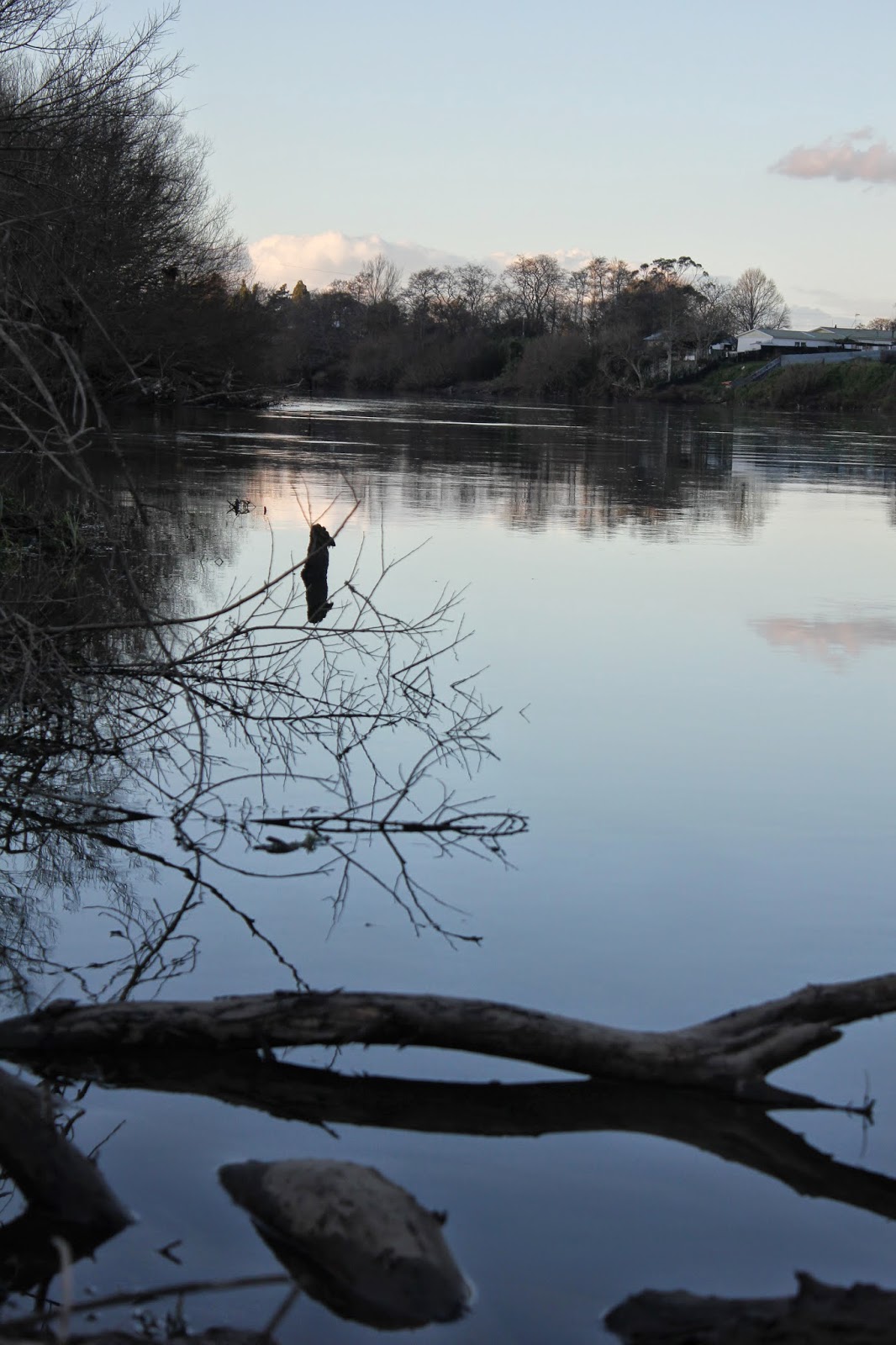 Seeing as Ngaruawahia's name involves a hangi, I should
probably explain what one is, but please don’t be put off by my description.
First a pit is dug in the ground, a fire is lit in the bottom, huge stones are
heated over it and then baskets of food are placed on top, meat at the bottom
and veggies on top. The hangis I have been to, involved quite a lot of tin
foil, which clearly isn’t traditional material, but there was also a goodly
covering of sack cloth before the earth went back over. It was left for several
hours and then dug up and we tucked in. Whilst on exchange to Calgary
University in Canada, my daughter and another New Zealander sought permission
to do a hangi for a ‘celebration of cultural foods’ day, thinking that it would
be awesome to demonstrate something significant from their homeland. Sadly the
Uni wouldn’t give them permission to dig the hole on campus and so alas, they
had to think of something else. But I can promise the students of Calgary - you
seriously missed out!
With our usual audacity, following the English invasion of the Waikato in 1863, British Imperial Forces renamed the town ‘Newcastle’. Latterly this explains some of the street names, such as Durham Street, but the name never stuck and Ngaruawahia determinedly stuck its chin in the air and shucked off the insult. My Hana Mystery Series is partly set in Ngaruawahia. Hana Du Rose purchased her home in the Hakarimata Ranges and ventures into this small town on numerous occasions. Her next door neighbour, Maihi, is related to most of the people in the town and through the 'cuzzie's grapevine' keeps her finger very much on the pulse of everyone's business. My characters are fictional but hopefully, epitomise the kind of Maori welcome and sense of belonging which we have been fortunate enough to be drawn into.
 |
| My Rahui Pole |
 |
| Main Street, Ngaruawahia |
I’ve had the privilege of being welcomed onto Turangawaewae Marae and enjoying a powhiri and a hangi there. Photos are prohibited once on the marae but I can promise you that it is beautiful, the tour was awesome and the sense of love that the elders have for the town and for their history is deep and genuine. The land on which my house is built was once owned by Te Wherowhero, the Maori king, confiscated by the defeating English. The curse has long since been removed by the kaumatua, as our guide reassured me, but there are dark areas around which still hurt from the bloodshed and the injustice. A paddock nearby, where my youngest daughter and I used to ride our horses, definitely contained something bad. If one of the horses was going to go loco, it would be in that paddock. If someone was going to fall off, it would be there. We stopped riding in it eventually, despite the fact that it was perfect in every other way. As a Christian, I walk and pray over our boundaries with my Rahui pole regularly, a piece of driftwood found on the riverbank of the Waikato at the edge of our property and inscribed by me, with the words of Psalm 90:9-11. Without exception, every Maori I’ve met has been respectful of my Christian beliefs. But it’s a fool who mocks and does not take seriously the spirituality of Maori and show it a healthy respect in return.

Until I took the above photograph, on a quiet Sunday afternoon, of the main street in Ngaruawahia, I had overlooked the influence of the Hakarimata Ranges. They are just there, quietly in the background, channelling a damaging north-easterly wind during winter and ensuring rain when our water tanks get low. I have been soaked in the ranges when the rest of the Waikato has been drought-dry and nobody would believe the 5 hours of soaking which I had shared with 2 class teachers and 60 wet Year 5’s. From that day onwards, my daughter’s teacher was nicknamed, Mr Noah and could never get parent helpers for a day out. Hamilton had enjoyed a lovely, dry, sunny day.
 |
| Near the police station, Ngaruawahia |
#NewZealand
#paradise
Subscribe to:
Posts (Atom)