Come in, relax, pick up a book and take a seat. Listen to writers give tips, talk about their lives and pass the time of day. Read until your heart's content and forget about what's going on outside. Isn't that what a library is all about?
Pages
Showing posts with label K T Bowes. Show all posts
Tuesday, 22 July 2014
Saturday, 19 July 2014
Authors’ Cave Grand Launch Festival Blog Train - the K T Bowes Carriage
Authors’ Cave Grand Launch Festival Blog Train
Welcome to the Authors' Cave Blog Train!
You are cordially invited to attend the
Grand Launch Festival Day!
Join us for what is sure to be a blast with the Most Enticing Book
Trailer Contest winner announcement, scavenger hunts, giveaways, Google social
hangouts, and our kick off for the 1st Annual Authors' Cave Book Awards where
you can win $500 cash, a Kindle Fire or Nook, and free promotion of your book
for a year at Authors' Cave!
July 22, 2014
(8am to 11pm EST)
Back to the train...Get to know the blogger - that's me!
3 sentences about myself:
I
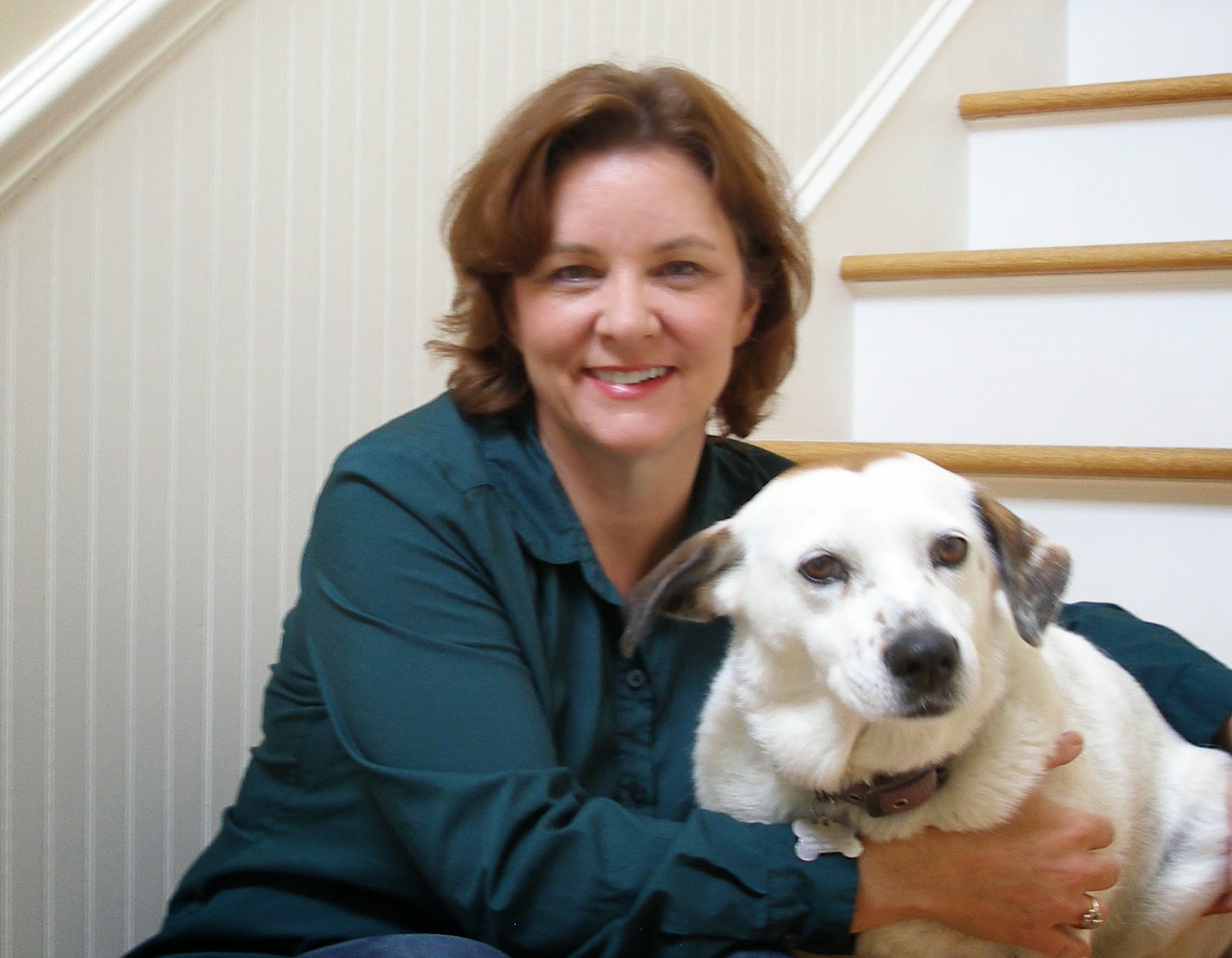
write as K T Bowes, although my real identity is a well-kept secret and trusted
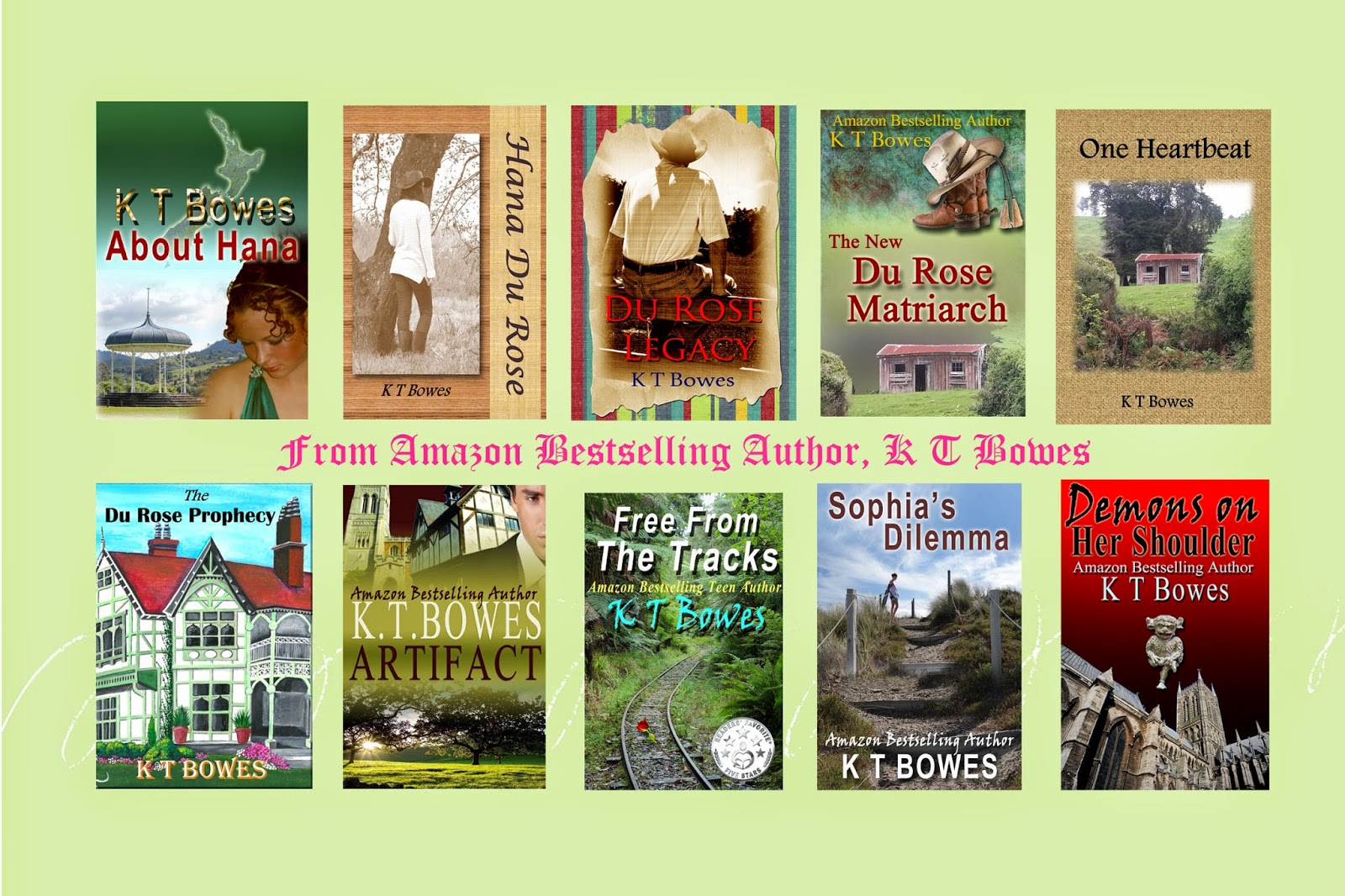
only to a few. I write The Hana Mysteries based in Hamilton, New Zealand, the
Teen Mayhem Series and have published two British based novels, Demons on Her
Shoulder and Artifact. Writing keeps me sane in a busy, frenetic life and
publishing and actually selling books, justifies my passion for it.
Elevator Speech: 2 sentences to 'sell' my books:
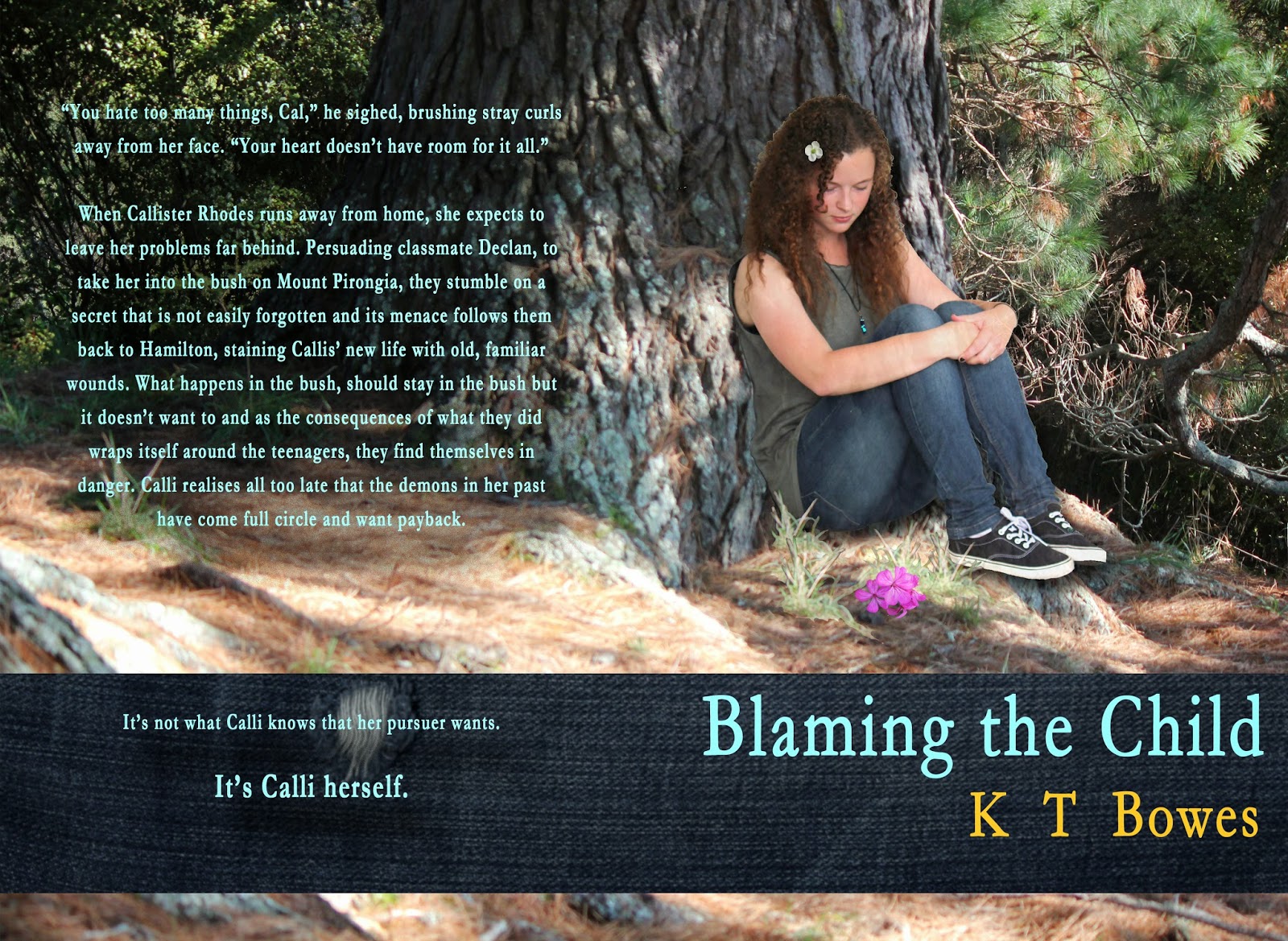
Blaming the Child
When teenager,
Callister Rhodes discovers an unimaginable secret hidden within the folds of
her struggling, dysfunctional family, she becomes a runaway, spending a
torturous week in the intimidating New Zealand bush with a chance companion. What
happens in the bush should stay in the bush but it doesn’t, following her into
the welcome fresh start and tainting everything it touches - because when you
can’t blame yourself, you end up blaming the child.
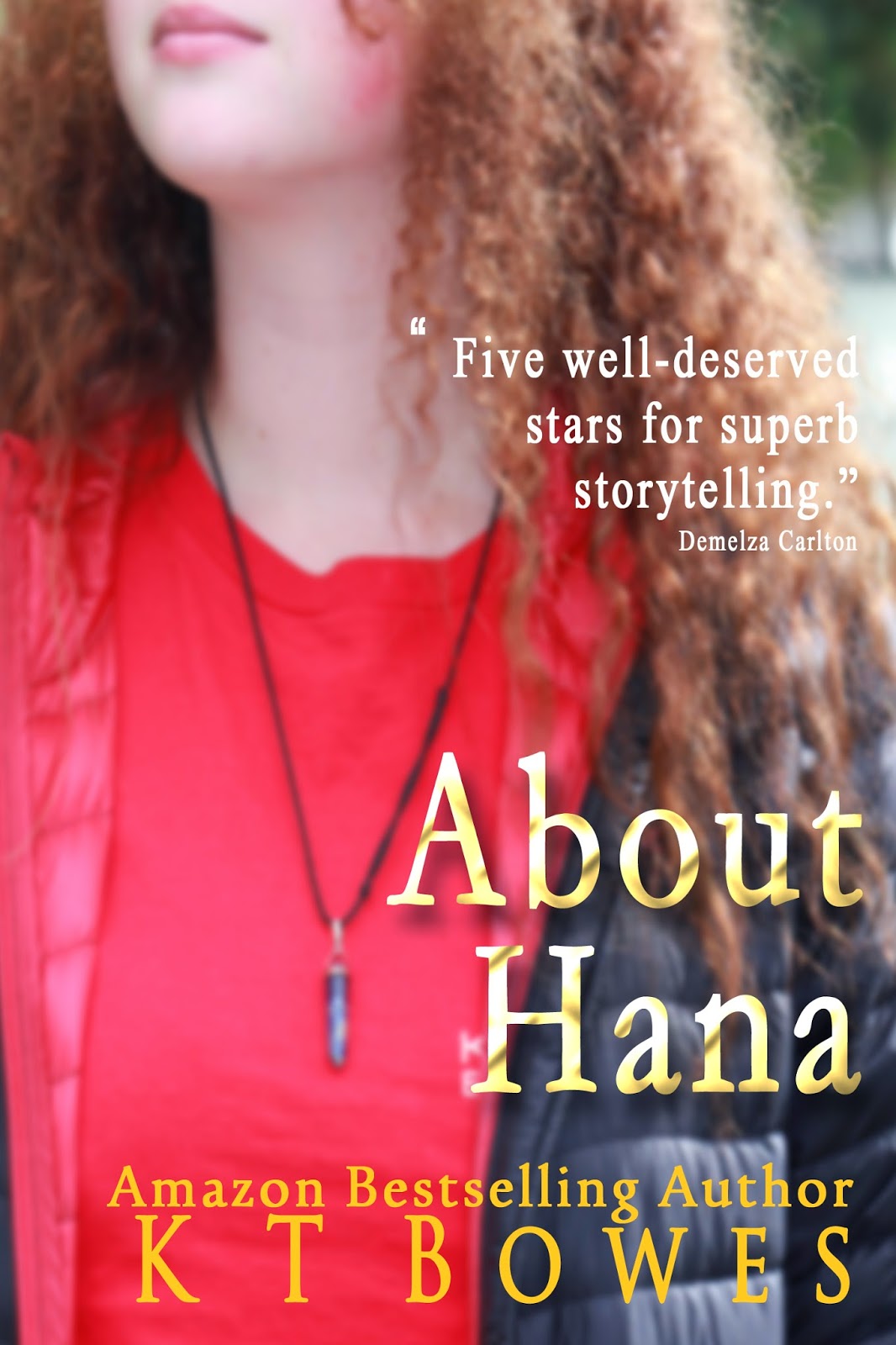
About Hana
It
seemed like a random mugging but when Hana is repeatedly followed by two men
with sinister intent, it is obvious that something else is going on in the New
Zealand city’s dark underworld and it alarmingly involves her. She’s given up
on love in middle age having been widowed young, but isn’t prepared for her unexpected
attraction to the new Maori head of the English department, whose unusual grey
eyes spark a peculiar feeling of deja vu.
The first three words I would use to describe myself are:
Compulsive, Over-thinker, Dreamer.
I am currently working on this project:
I am writing the seventh in the popular Hana
Mysteries, continuing the saga of the complicated Du Rose family. I am really
excited about The Secret Du Rose Son, which is fast paced and full of mystery
and intrigue.
My favorite thing about Book Review Depot /
Authors' Cave...
When I got my first novel onto the Active Review
List, I begged the administrator not to tell anyone but to let people find it
by accident. I felt self-conscious and sensitive about my writing and was
terrified of negative reviews. It felt like standing in a shopping mall
completely naked in the fruit section and waiting for people to start pointing,
laughing and criticising your stretchmarks. I can honestly say that being sent
by another author in the direction of the Book Review Depot was the single most
positive factor in my publishing experience and the support, camaraderie and
constructive criticism has been essential in developing my skill as a writer. There is a core of solid, accomplished authors on BRD but
it’s not enough just to click the ‘join’ button, you certainly get out what you
put in. Ask questions, join the discussions and offer your own experience or
even referee when it gets passionate. I think I hold pole position for asking the
stupid questions so don’t worry about looking an idiot. That spot is already
taken!
Enough about me...here are 3 more books from Authors' Cave you might enjoy!
Stay on the train and follow these authors next!
See how they responded to the same questions!
The Riddle of Prague by LauraDeBruce
http://theriddleofprague.com/blog/
http://www.amazon.com/Riddle-Prague-QuickSilver-Legacy-ebook/dp/B00FFBNUVA/ref=sr_1_1?ie=UTF8&qid=1404403096&sr=8-1&keywords=riddle+of+prague
Running by Barbara Spencer
http://ablogpd.blogspot.co.uk/
Pawn of Innocence by Chameleon Author
http://chameleon-author.blogspot.com
http://www.amazon.com/Pawn-Innocence-Chameleon-ebook/dp/B00DT99BX6/ref=tmm_kin_swatch_0?_encoding=UTF8&sr=8-1&qid=1405347551
Answer to Grand Launch Festival Day Scavenger
Hunt Question #3: Train
Saturday, 5 July 2014
Ocean's Infiltrator Review - The Addictive Ocean's Gift Series
Ocean's Infiltrator - a review
This novel, the second in the Ocean’s Gift series is yet another page turner. It demands to be read in one sitting, to the exclusion of all other calls on the reader’s life including eating or sleeping.
I still love Joe. I love his bumbling humanness and his worship of Sirena and I spent the entire book in as much agony as Joe, believing that she would leave him high and dry and return to her people. The ending is incredible and I should have seen it coming, but didn’t. I won’t spoil it, even though I badly want to tell.
Demelza Carlton spins an incredible yarn, which wraps around the
reader and pulls tight, too tight to escape from easily. She is obviously an
immense researcher, who understands the oceans and their peculiarities in
depth. Her books have made me wonder about many recent nautical disasters and
their perilous origins and if the stories of old, about fantastical sirens who
sang from rocks and lured ships to their deaths may in fact be true.
This
novel is awesome and I devoured it. It is as much a study of behaviour and
relationships as a book about mermaids.
Demelza Carlton has always loved the ocean, but on her first snorkelling trip she found she was afraid of fish.
She has since swum with sea lions, sharks and sea cucumbers and
stood on spray-drenched cliffs over a seething sea as a seven-metre cyclonic swell
surged in, shattering a shipwreck below.
Sensationalist spin? No - Demelza tends to take a camera with her
so she can capture and share the moment later; shipwrecks, sharks and all.
Demelza now lives in Perth, Western Australia, the shark attack
capital of the world.
The Ocean's Gift series was her first foray into fiction, followed
by the Nightmares trilogy. She swears the Mel Goes to Hell series ambushed her
on a crowded train and wouldn't leave her alone.
The suggested reading order for each series is as follows:
Ocean's Gift series:
Ocean's Gift
Ocean's Infiltrator
Water and Fire
Turbulence and Triumph (to be released in 2014)
Ocean's Depths (to be released in late 2014)
Sunday, 22 June 2014
The Writing Process Blog Tour
I’m really pleased to have been tagged to take part in this tour by Regina Joseph, author of the Alterran Legacy Series in the sci-fi genre. She is an author whose work I have very much enjoyed. If you want to see more of Regina Joseph, her author page can be found at,
http://www.amazon.com/Regina-M.-Joseph/e/B00AQ4RCRE/ref=sr_ntt_srch_lnk_3?qid=1403310721&sr=1-3
So, here are some insights into what makes me
tick as a writer. I wish my answers didn’t make me look so haphazard, but we
are what we are I guess. I could have lied and made stuff up, but I didn’t. Promise.
What am I working on?
At the moment, I am re-editing About Hana for the millionth time because I am obsessive about novels being ‘clean.' I can’t stand editing errors. It had been my intention to have a break from writing and tidy up some of my older works, but I now have another storyline which is growing in my head by the day. It sometimes happens like that, but this one is definitely not going to go away so I need to get it written down.
Writing is a treat for me and so I
can use it as a reward if I do enough editing. Oh, that’s in between the family and the day
job.
How does my work differ from others of its genre?
I guess that I write what I want. I don’t sit
down and decide that this book is going to be a romance or this one is a
mystery - I just write it. I have been known to get stuck after the novel is
complete and fully ready to go with its wee cover on and sit there wondering
which genre to put it in. Sometimes it really is a question of, ‘Mmnn, what are you?’ at the eleventh
hour. I seem to cross genres quite a lot within one piece of work.
Artifact is intrinsically a romance but is intercontinental, crossing from New Zealand to England. It also contains some scenes from English history with references to the English Civil War and that’s always difficult to place. I guess that’s why my work is so different, because it meanders across acceptable genre lines without worrying.
The Hana Mysteries are essentially that
- mysteries, but are bound up in the deeply entrenched Maori family that Hana
marries into. There is family intrigue within that dynamic which is culturally
interesting and then underneath, there is always an external issue that causes
danger or disaster for Hana. Yet my favourite aspect of the Hana series is the
romance between her and Logan because it is so complicated and undulating.
So again, what are those books? Mystery, romance, New Zealand culture, family. They are a myriad of things all rolled into one.
Why do I write what I do?
Ultimately, I write the kind of stories that I would like to read. If I’m paying good money for a book, what would it have to be or contain?
Writing for me, is easily as fulfilling as reading and I think
that is a factor in what I produce. I have lead female characters because I am one.
I could write from a male perspective but can get far more psychologically in
depth with another female. My Hana character has a few hallmarks belonging to
me and I am comfortable with her. She is a frustrating over-thinker who worries
about silly things (me) and yet at other times she can be dogged and stubborn
with enough pluck to be gutsy and interesting (probably not me.) If she was a
real person, I would spend half my life wanting to have coffee with her and the
other half being driven mad by her.
I love my secondary male characters (perhaps a
little too much sometimes) and am fascinated by how they grow and become shaped
by the storylines, often without much input from me. Logan Du Rose began as a
mysterious Maori with an intense attraction for Hana. At first it seemed
incongruous and they were so poorly matched but as the series progressed, I
fell in love with him myself. He has become this Godfather figure, this all
powerful bad-boy in cowboy boots who masquerades as a highly intelligent school
teacher. He did that himself.
My teen novels fill a gap I think. Again, I
don’t plan them. I sit down at my computer and out they come. Blaming the Child began harmlessly, as a
story about two teenagers who lived next door to each other. In fact the
working title was ‘Bad Neighbours’. Nobody was more surprised than me when the
novel began dealing with issues such as self-harm, rape, teenage sex, runaways
and parenting issues. Experience is different for everyone but I know that my
writing has been cathartic for me personally. I think that the only rule in writing is to
stick to what you know.
Demons On Her Shoulder began as a book about a counsellor and went on from there. I don’t think that you can convincingly write about sexual abuse in a detached way. Readers aren’t stupid - they know when something is based purely on research and it doesn’t convince them. So in that way, there’s a real vulnerability in producing novels that deal with this issue. It’s a huge risk but I have had some lovely emails, especially about Demons, even though it was never meant to be a self-help book at all.
How does my writing process work?
I would love to give a really intelligent
answer to that question. Unfortunately, there is no rhyme or reason for what I
write or when I write it. Shakespeare wrote a lot about his ‘muse’ and I know
that artists talk about this concept as though it’s an ethereal being. But it
feels exactly like that sometimes, like this thing has occupied your brain and
put all these plot lines and story arcs in there. You literally can’t relax
until they’re all out.
If you imagine a woolly jumper that someone’s unpicking, they pull on the end and the whole thing eventually collapses and disappears in front of your eyes. It’s a lot like that. You pull the thread and it unravels inside you only sometimes it gets a knot which needs undoing. The end result has to be a neatly rolled ball of wool even if there was once a whole lot of messy strands on the floor in front of you. Some days it’s a flowing thing and other times a wrenching one, but it has to come out entirely for the author to feel satiated.
I wrote One Heartbeat
like that. I was like a crazed madwoman. I remember it being winter and I went
through the motions of going to work and sorting out the family, but I have no
memories of anything about that time in my life. It’s as though I wasn’t really
here, I was up in the mountains above Port Waikato at the hotel sharing Hana’s
trials. For me it can act as a huge abdication from
life, which isn’t really fair on my family. When I wrote that particular book,
we had a lot going wrong for us and it helped me to rise above it actually. I
would have normally got depressed, in fact I should have got depressed with all that was going on, but nothing
seemed to touch me. I was particularly cruel to Hana at the end though and when
I look back, I think I was trying to sever the connection and make her let go
of me so that I could come back to the real world.
I wish I could offer up some carefully coiffed
plan for that question, which made me look really wonderful. If I was looking
for a name to call my own personal writing process, it would have to be ‘The
Headless Chicken Writing Process.’ The definition of that would be - no pattern, no direction, just running
around blindly and getting surprisingly far whilst being observed with interest.
If writer’s block is like creative
constipation, then I am blessedly at the other end of the digestive scale right
now and very thankful for it. My father always said that I had verbal
diarrhoea...
So, who have I tagged to be next on the blog hop?
The next author that I am going to tag on this blog tour is actually one of my favourites.
Terry Maggert is probably the next DH Lawrence and I read his first novel, The Forest Bull in awe of him. His writing has a real intelligence to it and if I could have given more than five stars in my review, I definitely would have. Terry is an author whose coat tails the rest of us can only dream of holding onto. He is definitely a writer who is going places fast.
Terry’s biography
Born in 1968, I discovered fishing shortly after walking, a boon, considering I lived in South Florida. After a brief move to Kentucky, my family trekked back to the Sunshine State. I had the good fortune to attend high school in idyllic upstate New York, where I learned about a mythical substance known as "snow".
After two or
three failed attempts at college, I bought a bar. That was fun because I love
beer, but, then, I eventually met someone smarter than me (a common event),
and, in this case, she married me and convinced me to go back to school--which
I did, with enthusiasm. I earned a Master's Degree in History and rediscovered
my love for writing.
My novels explore dark fantasy,
immortality, and the nature of love as we know it.
I live near Nashville, Tennessee, with the aforementioned wife, son, and herd, and, when I'm not writing, I teach history, grow wildly enthusiastic tomato plants, and restore my 1967 Mustang.
Links to Terry Maggert, author - well worth a look.
http://www.amazon.com/Terry-Maggert/e/B00EKN8RHG/ref=ntt_athr_dp_pel_1
My next author to nominate is:
CB Pratt
CB Pratt is an author
whose work I have happily reviewed. I love her Eno the Thracian novels with her
dashing, tongue-in-cheek hero who makes me laugh.
C.B.
Pratt has lived all over the United States, including California, New York and
many stops in between. Having been a professional writer for over twenty years,
she is ill-suited to any normal work and hopes to continue writing for the rest
of her life. Independent publishing has allowed her to write the things she has
always wanted to, including fantasy and steampunk. She is the author of
numerous traditionally published books, as well as the Eno the Thracian
fantasy-adventure series. RIVERS OF SAND will be released late summer, 2014.
Sample or purchase Book 1 in the series:
And last but not least, an author for whom I have a great deal of respect:
Venkatesh Iyer
Venky and I chat often on the Book Review Depot, from where I know all of the three authors I have tagged. He has a wicked sense of humour and always has something useful to add. I find his blogs about writing immensely useful and am looking forward to his collection of short stories.
General Manager in a big
trading concern at a young age, bank executive thereafter, before becoming an
entrepreneur in the third stage of my working life: that was me before I
decided I had had enough of the world of commerce (my businesses died a lingering
death because of the Maoist insurgency in Nepal). I moved to Chennai, and
finally, late in life, took up something I was born for, and unfortunately,
knowingly blind to: writing.
I am at the computer all
day, writing for my blog, for LinkedIn (I recently received publishing rights)
and most of all, on my book of short stories, most based on real life, and all
to do with a scheming but bumbling politician who would be Caesar. I intend to
publish it as my first fiction book, in both digital and print versions. I have
published three non-fiction works, all in the digital form.
I do freelance editing jobs, all for publishers of
non-fiction, like Oxford Printing Press.
I am interested in current news, movies, reading and music (in which my tastes go back to the
60s, 70s, and 80s).
I believe in social media, because I believe in social participation.
I believe in myself, once again, after years of
self-rejection.
I blog at:
www.venkyiyer.com. google.com/+venkyiyer and http://www.twitter.com/user/venkyiyer58
https://www.linkedin.com/in/venkyiyer58
Saturday, 21 June 2014
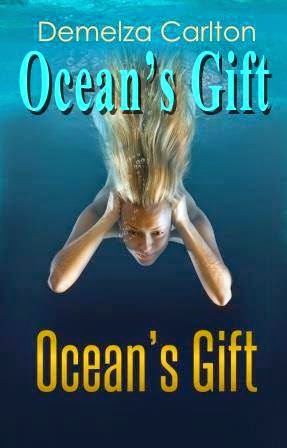
Ocean's Gift by Demelza Carlton
I
liked Water and Fire, but I loved Ocean’s Gift. It was fascinating seeing
Belinda in her mermaid setting, as I had got to know her in the first novel
even though I knew little of her background. But in this novel, I adored the
character of Vanessa. She had an innocence and yet a matriarchal power that was
really enticing. I felt as though there was an opportunity to really get to know
her. Demelza Carlton has struck the perfect balance between the archetypal view
of mermaids and that of the sirens of old, blending the two to make a tender
and yet dangerous species of females.
The
storyline is awesome and frighteningly plausible. The earth is dying and nature
will have seen the tell-tale signs long before man pulls his head out of the TV
and realises it.
Joe
is a decent man in a world full of typically bawdy males. He is solid and honourable
and bashful without losing any of his sex appeal. He is reassuringly male
without the unappealing baseness of the other fishermen, which is probably why
Vanessa picks him. The mermaid race seeks liaison with men as a duty, but
Vanessa is different. She has previously known love and it presents a
vulnerability within an otherwise fearsome character portrayal.
I
love how truly Australian this novel is. It has all the raw beauty of a
stunning corner of the world. I appreciated the descriptions of the geography
and the oceans; they were colourful and well-drawn and made the reader feel as
though they were taking part in the novel. I was there in Joe’s hut and Vanessa’s
boat. I liked this novel enough to read it in one sitting, not wanting to put
it down and miss anything. It had enough of a hold on me, to keep me from doing
the myriad other things that I actually should have been doing and I felt sad when
the last page had been finished and savoured. I would have felt more
devastated, had I not known that there were other books in the series to pick
up.
It
was incredibly well written and refreshing clean editorially - not a single
distracting flaw to spoil the reading experience. I would definitely recommend
it.
Get your own copy of Demelza's awesome book on Amazon:
Monday, 9 June 2014
KEEPING IT REAL - Giving the reader the benefit of your real-life experience.
I
read a novel once which contained a foreword by the author and referred to a
week that she had spent in the bush doing research. I sat back and began
reading, excited to see her experiences drifting through the pages at me. I was
severely disappointed. By the end of the book, her lead male had made a fire
without matches and built a small bush hut. That was it. She had literally
spent a week living rough for a few lines about how delightful it was and how
clever her man could be.
Whilst
writing my latest work, I sent my two main characters into the New Zealand
bush, on Mount Pirongia to be exact. I was keen not to make the same mistake
and so I used my own experience to hopefully put the reader into that
situation. The bush is beautiful and challenging and utterly terrifying. It is
not the kind of place that you can afford to disrespect. I hope that I have
managed to get that across.
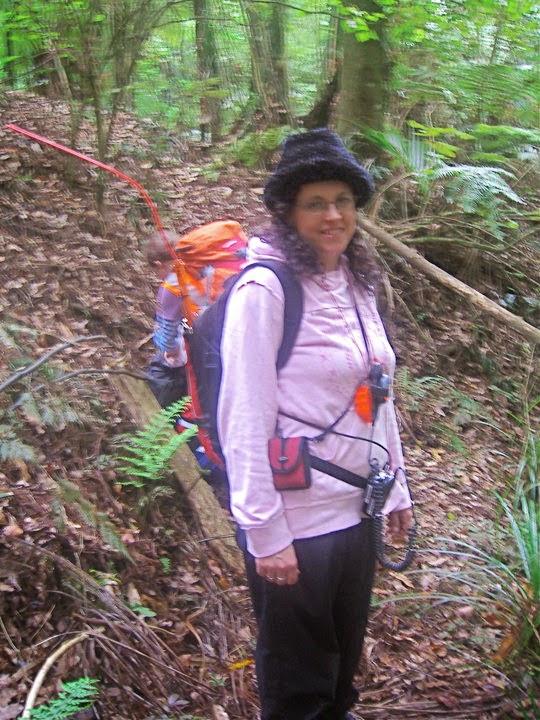
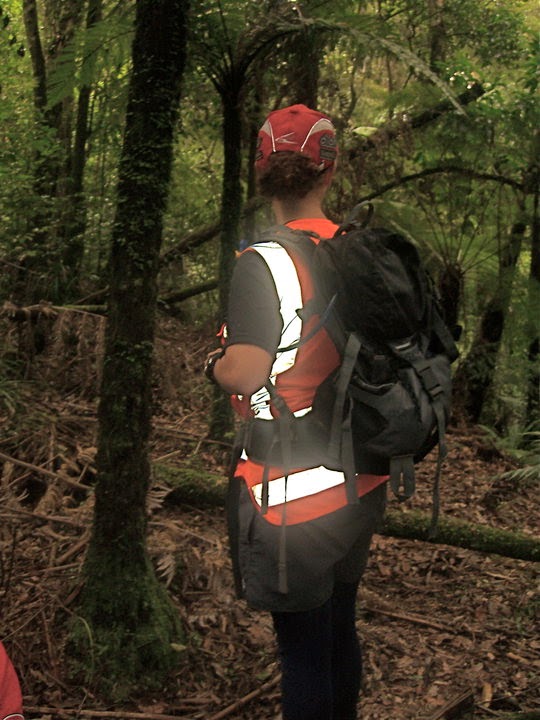
The
first night I ever spent in the bush was up in the Kaimai Ranges in the middle
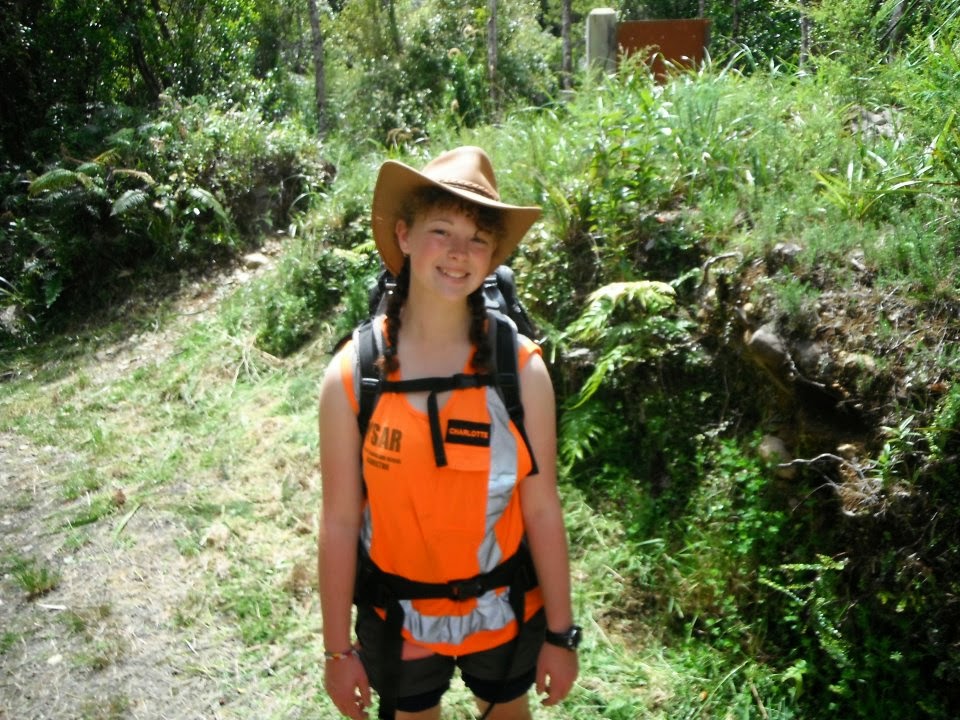
of a wintry July. It was a Youth Search and Rescue event and I was accompanying
my fourteen year old daughter on a Parent Camp, having drawn a very short
straw.
Let’s
make this clear. I am a 5* hotel kind of girl. I don’t do camping.
Yet
there I was, waking up in a tent packed with snoring adults of both genders,
fervently telling myself that I didn’t need the toilet. Unfortunately, I did
and let me tell you, once you’re out of the tent, there ain’t no point trying
to crawl back in again. It was freezing cold and into the minus figures and the
promise of home and bed felt like the Holy Grail. We had camped next to an
elderly scout hut with a toilet and freezing cold running water, but that, I am
reliably informed, was a luxury.
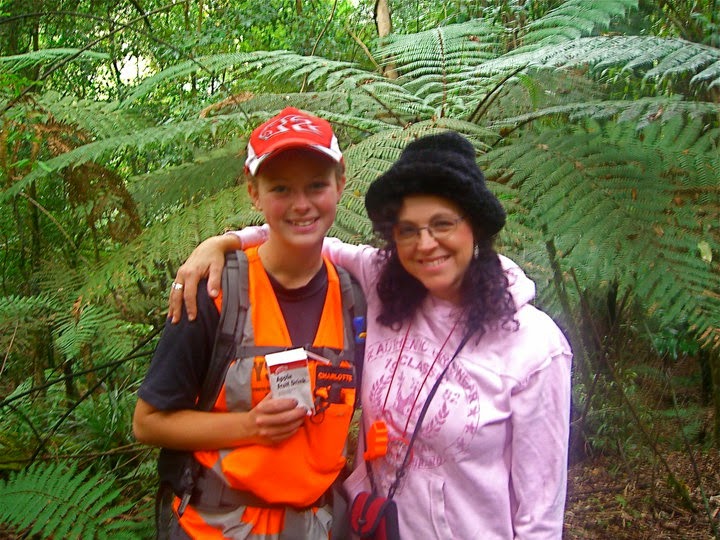
My
daughter had joined this motley band of crazies a few weeks after her
fourteenth birthday and they trained rigorously every second weekend on any of
the mountain ranges surrounding Hamilton. Over a period of three years, she
morphed from an outdoor loving teenager into a finely honed machine, able to
survive alone in the bush for days, navigate anywhere with an ordinance survey
map and compass, track and find, administer first aid to and rescue
unfortunates who found themselves lost. By the age of sixteen, she was carrying
a pager and responded to search calls, even leaving school to do so. As parents,
we were so proud. But then in the middle of each year...there was Parent Camp.
The
first year, I went off on a ‘tramp’ with an older boy and another parent. We
chose a short track, because I am not a fan of deeply wooded areas and as we
discovered half way around, the other poor mother was three months pregnant and
but for her husband being called away, shouldn’t have been crawling, knee deep
in vines and bush matter anyway. We had radios and a GPS, not that we were
allowed to cheat, tempting as it was and we were being monitored back at base
by a group of third years which must have found our weaving coloured line
absolutely hilarious.
All
of the parents were loaded up with rucksacks containing emergency clothing and
a small survival kit, food and water to last us should we get hideously lost
and need to camp out. Good grief!
Surely that should have told us what we were in for but no, off we went like
innocent lambs to the slaughter.
There
is a moment in my latest novel, Blaming
the Child, when Callister is forced to tramp off track through deep bush.
She is scratched by the hooky thorns of bush lawyer and constantly tripped up
by supplejack, spending most of the time on her hands and knees. That was me! I have truly never felt so
helpless. For as far as I could see in every direction, it all looked the same.
I could see how easy it was to get lost. Over five awful hours, I learned to
navigate using a compass and also saw how simple it could be to trust your own
judgement about where you were headed and topple off a ridge or into a water
course. I got to use the radio and call in our coordinates, feeling a total
fool when I got the lingo wrong and had to be straightened out by a teenager.
It was both humbling and humiliating.
The
second year, I had the privilege to be led on a tramp by my own daughter. She
had suffered a dreadful head injury at the end of the previous year, being
caught in a rock fall and received a bravery award. Miles from help, her head
had been kept from falling apart using a handkerchief and a bright orange
Search and Rescue baseball cap for an incredible twenty four hours. Then she walked
6km carrying her own pack, to civilisation, a horrified mother and hospital.
She recovered and apart from the scar on her forehead and a wariness of scree
slopes, she lost none of her passion for the bush and rescuing other people
from its clutches.
Unfortunately
by the end of our master class, my beautiful daughter declared me to be a ‘liability.’
I have a tendency to wander off after butterflies and pretty plants and she
spent half an hour searching for me and the other parent whom I had
inadvertently led astray. I have no idea how we ended up on the other side of that
stream as neither of us adults remembered crossing it. I also disgraced myself
by eating particularly poorly. While everyone else unwrapped hearty sandwiches
and sensible energy bars, I created a stir by whipping out a tin of English
mushy peas which I had lumped around in my rucksack. Having produced a tin
opener and a dessert spoon, I horrified my poor daughter by eating the little
green darlings cold, washed out the tin in the stream and carried it back to
the scout hut, clanking loudly all the way.
Needless
to say in her third year, she didn’t press me to attend with quite the same
degree of excitement.
My
character, Callister Rhodes, is a lot like me. She is surrounded by beauty but
would rather not be. The New Zealand bush is both fascinating and terrifying
and she doesn’t cope well with its isolation. It makes her feel powerless and
causes her to question her own significance against the benchmark of its
magnificence. If it weren’t for the competence of her companion, Declan Harris,
she would not have survived.
Declan
is like many of the young men and women whom I encountered on those weekends.
He is infinitely capable and very much at home in his surroundings. Unlike
Calli, he would be perfectly happy to live indefinitely in the bush. He has
been well trained by a bush loving father, who taught him everything he knew,
before dying prematurely.
I
have been careful not to over-egg the pudding. My characters could have hunted
for their food, surviving on rabbit or eel, but I wanted it to be realistic. It
wouldn’t matter how hungry I got, I would never be able to stomach a slime
covered eel, no matter how well you washed it and my daughter informed me
knowledgeably, that rabbits would not be found on the upper slopes of the
mountain, only in the lower farmland areas. Declan provides food for Calli,
made up of dehydrated mince and powdered mashed potato. I may be criticised for
this but can assure you, that my daughter and her companions survived happily
on such ingredients for each of her weekends and the ten day trips which they
did every New Year. I should know. I was in charge of firing up the dehydrator
and the smell of it running overnight was pretty disgusting. But she required
enough meals to last for ten days and that was my contribution. There is almost
nothing that can’t be dehydrated and some things are more successful than
others. Tinned fruit mushed up and spread over the shelves of the dehydrator
comes out like fruit bar - bet you didn’t know that!
Above
all, I truly hope that my novel has realism. The last thing I want is someone
to slam the book down and declare that the author has clearly never experienced
the bush. I want you, the reader to know that I have, I did and I really don’t
want to again.
Saturday, 31 May 2014
Wanted - Serial Joiners, Dead or Alive.
I’m
not really a serial ‘joiner’ to be honest. I tend to be the person that pulls a
face at wedding invitations and ends up going out in the cold to the mall on a
Saturday night, just to disprove the lie I told about being too busy to go to
the birthday party. The lengths I’ve gone to in order to spend my life getting
out of things, makes me wonder if sometimes, it would have been easier to show
up for a few hours, drop off the obligatory present and then leave when
decently acceptable.
So what changed when I started publishing my work?
I decided to write a list of ten reasons why I joined all the myriad sites I seem to be a silent member of, in the hope of preventing someone else from going ever so slightly insane spending their life typing...without producing a single chapter of their novel.
1. Well, for starters, it’s a pretty isolating experience. You write by yourself, figuratively even if you can’t manage it literally. Yes the children were climbing the curtains, but you were happily ensconced in a fantasy world or stuck in a hotel with a pair of love birds. You saw what your offspring were doing, but only stopped typing when you heard the ripping sounds and were forced to grumpily tear yourself away from the keyboard. If you weren’t a loner before you started writing, you soon will be. I’ve agreed to all sorts of stupid, random things, just to get a bit of peace and quiet to finish a chapter or two. Writing makes you lousy company. You join sites, pages and groups to find kindred spirits.
2. We are told as authors that social media is our friend.
Who told us this? Well, people on social media of course. So we grab as many sites as we can, setting up pages for this and blogs for that. Then we fail to remember what we actually signed up to and definitely didn’t anticipate the hours of work that maintaining the monster would take. It eats at our writing time like a page eating dinosaur and ensures that the kids get beans on toast for their tea for the fourth night running. That’s ok. They haven’t bathed for a week so you don’t recognise them anyway.
3. Our own sense of creative inferiority means that we have to obtain everything that other authors have. If they have an account with a book site and claim to have made a sale through it; we have to join. We forgot to put it in our favourites, cringed at the number of immediate messages asking us to join this or that forum on the site and two weeks later will try to join it again, bemused when the site tells us that it recognises our email address and would we please enter a password - which we now can’t remember.
4. We want sales obviously, but what we also need is the lifeblood of authorship - reviews. Anything that promises ‘honest reviews’, we will join. We set off after them in the spirit of Indiana Jones searching for the Holy Grail and return battered and broken having acquired none - or none that we ever want to read again anyway.
5. Like the silly children who skipped gaily after the Pied Piper, we follow other authors into hell and back, because we once struck up a conversation with them online and assumed that they knew what they were doing. We end up in forums where we and our work are horrifically tortured by ghouls who lurk in the shadows waiting for suckers like us to just show up, with our wide eyed innocence and pretty copies of our nice book to give away for free. What's your problem, you joined it, didn't you?
6. Joining becomes as addictive as checking our sales on the KDP reports page. It’s like we actually believe that the more we check, the likelier it is that someone will have hopped on and made a purchase in the last two minutes while you were stirring the baked beans. If we are online and ever present, that same anonymous someone will see us, like us and buy something, especially if we put our best foot forward and smile, smile, smile. Hunt them down and join where they're joined.
7. A hint of the dollar sign and we’re there, like flies around a cow pat, jockeying and jostling to be first to join, even though there is no such thing as a free lunch and any offer that is too good to be true, probably is a big fat con. We might have to part with a little something up front and we agonise and worry, but hand the money over anyway, justifying it to ourselves as we raid the biscuit tin where we were saving up for school shoes. It will be ok, our books will pay us back. Won’t they?
8. Instead of giving ourselves a break and enjoying flexing our creative muscles, we put ourselves under pressure, berating our partners for the lovely meal they took us out for to soothe our frazzled nerves - because we weren’t online for a whole two hours (if you don’t count taking your phone to the toilet for a quick peek at Facebook.) It’s not just that we haven’t joined anything in two days, we’ve actually run out of things to join. We’re everywhere, like a bad smell, waving our book and shrieking, ‘Buy this, buy mine...please...anybody?’
9. We suddenly discover that we are ‘all joined out’. The task is too massive for a single human being. We physically can’t do all the unrealistic tasks we have set ourselves. We can’t fulfil our obligations to post, tweet, blog, comment and message. There just aren’t enough hours in a day, even if we don’t change out of our pyjamas and get a shower. We join a different site and automate it, thinking that we’ve found the solution. But then we have to monitor the autobots, who email us just as regularly as all the other sites we joined earlier, telling us who followed and unfollowed us and giving us something else to worry about.
10. After a miserable bout of self-doubt, during which time, we realised that we hadn’t written a single chapter all week, we go back to the keyboard and try and undo the damage. We spend hours trying to remember what we joined so that we can un-join ourselves, tying our brains up in knots as we reset thirty different passwords in one sitting and try and sort out the mess. As we fall into bed feeling marginally satisfied, we just allow ourselves one little peek at our sales reports and hey, what the heck, we sold a book...on Thursday. Oh crap, I think to myself. I bet they saw it on that site with the funny logo. I should probably rejoin...
So what changed when I started publishing my work?
I decided to write a list of ten reasons why I joined all the myriad sites I seem to be a silent member of, in the hope of preventing someone else from going ever so slightly insane spending their life typing...without producing a single chapter of their novel.
1. Well, for starters, it’s a pretty isolating experience. You write by yourself, figuratively even if you can’t manage it literally. Yes the children were climbing the curtains, but you were happily ensconced in a fantasy world or stuck in a hotel with a pair of love birds. You saw what your offspring were doing, but only stopped typing when you heard the ripping sounds and were forced to grumpily tear yourself away from the keyboard. If you weren’t a loner before you started writing, you soon will be. I’ve agreed to all sorts of stupid, random things, just to get a bit of peace and quiet to finish a chapter or two. Writing makes you lousy company. You join sites, pages and groups to find kindred spirits.
2. We are told as authors that social media is our friend.
Who told us this? Well, people on social media of course. So we grab as many sites as we can, setting up pages for this and blogs for that. Then we fail to remember what we actually signed up to and definitely didn’t anticipate the hours of work that maintaining the monster would take. It eats at our writing time like a page eating dinosaur and ensures that the kids get beans on toast for their tea for the fourth night running. That’s ok. They haven’t bathed for a week so you don’t recognise them anyway.
3. Our own sense of creative inferiority means that we have to obtain everything that other authors have. If they have an account with a book site and claim to have made a sale through it; we have to join. We forgot to put it in our favourites, cringed at the number of immediate messages asking us to join this or that forum on the site and two weeks later will try to join it again, bemused when the site tells us that it recognises our email address and would we please enter a password - which we now can’t remember.
4. We want sales obviously, but what we also need is the lifeblood of authorship - reviews. Anything that promises ‘honest reviews’, we will join. We set off after them in the spirit of Indiana Jones searching for the Holy Grail and return battered and broken having acquired none - or none that we ever want to read again anyway.
5. Like the silly children who skipped gaily after the Pied Piper, we follow other authors into hell and back, because we once struck up a conversation with them online and assumed that they knew what they were doing. We end up in forums where we and our work are horrifically tortured by ghouls who lurk in the shadows waiting for suckers like us to just show up, with our wide eyed innocence and pretty copies of our nice book to give away for free. What's your problem, you joined it, didn't you?
6. Joining becomes as addictive as checking our sales on the KDP reports page. It’s like we actually believe that the more we check, the likelier it is that someone will have hopped on and made a purchase in the last two minutes while you were stirring the baked beans. If we are online and ever present, that same anonymous someone will see us, like us and buy something, especially if we put our best foot forward and smile, smile, smile. Hunt them down and join where they're joined.
7. A hint of the dollar sign and we’re there, like flies around a cow pat, jockeying and jostling to be first to join, even though there is no such thing as a free lunch and any offer that is too good to be true, probably is a big fat con. We might have to part with a little something up front and we agonise and worry, but hand the money over anyway, justifying it to ourselves as we raid the biscuit tin where we were saving up for school shoes. It will be ok, our books will pay us back. Won’t they?
8. Instead of giving ourselves a break and enjoying flexing our creative muscles, we put ourselves under pressure, berating our partners for the lovely meal they took us out for to soothe our frazzled nerves - because we weren’t online for a whole two hours (if you don’t count taking your phone to the toilet for a quick peek at Facebook.) It’s not just that we haven’t joined anything in two days, we’ve actually run out of things to join. We’re everywhere, like a bad smell, waving our book and shrieking, ‘Buy this, buy mine...please...anybody?’
9. We suddenly discover that we are ‘all joined out’. The task is too massive for a single human being. We physically can’t do all the unrealistic tasks we have set ourselves. We can’t fulfil our obligations to post, tweet, blog, comment and message. There just aren’t enough hours in a day, even if we don’t change out of our pyjamas and get a shower. We join a different site and automate it, thinking that we’ve found the solution. But then we have to monitor the autobots, who email us just as regularly as all the other sites we joined earlier, telling us who followed and unfollowed us and giving us something else to worry about.
10. After a miserable bout of self-doubt, during which time, we realised that we hadn’t written a single chapter all week, we go back to the keyboard and try and undo the damage. We spend hours trying to remember what we joined so that we can un-join ourselves, tying our brains up in knots as we reset thirty different passwords in one sitting and try and sort out the mess. As we fall into bed feeling marginally satisfied, we just allow ourselves one little peek at our sales reports and hey, what the heck, we sold a book...on Thursday. Oh crap, I think to myself. I bet they saw it on that site with the funny logo. I should probably rejoin...
Wednesday, 28 May 2014
Bring Back The Emotional Rollercoaster
I’ve
read some incredible books recently. I’m currently reading Threads by Tom Tinney - it’s completely out of my genre and my
comfort zone, but I’m hooked by his characterisation of many of those he’s
drawn into his intrigue. No, I don’t usually ‘do’ aliens, or space for that
matter, but I’m utterly hooked by the marshals in his novel. They are
believable, totally plausible and I want to be there when they win through.
I’ve
also read some shockers in my time. By that, I mean that I’ve got to the end of a novel
having been sped through exciting fight scenes, scintillating dialogue and
amazing mysteries that I couldn’t have thought up. I know who killed who and
why, where they live and what they ate. I know what kind of music the main
characters listen to, but possibly don’t actually recognise any of the bands
that they slow danced or drove to. I know that they had some kind of health
need because they took a pill which I cannot name, but then worse, far worse, I don’t
know what they look like or what actually makes them tick on the inside.
We
only have to look around us to find a smorgasbord of human emotion. It’s
everywhere. Literally. It doesn’t matter where you work, there is bound to be
someone loud, someone strangely quiet, someone with emotional problems, someone
who drinks too much. Marriages break up every day. Add that to your own
experience of grief and you have a veritable emotional soup. I’ve read some
novels with awesome storylines, where the appointed heroine watches the love of
her life walk away or draw their last breath and shrugs, picking up the strands
of her life and trotting off in the other direction. What’s with that? Within two chapters, she’s snagged herself a more
suitable replacement and on we go. In ‘About Hana’, I allowed eight years to
have elapsed before my character could even consider the possibility of
remarriage. Sometimes in life it does honestly happen sooner, but come on! Two
chapters?
There
is an insincerity which creeps into some novels. They begin well and I can’t
work out whether there’s a lack of skill in the actual writing, or if some
overzealous editor has gone through and removed all the character-related
information in favour of fast paced action. The trouble is, it breeds an
immaturity in the characterisation and as a reader, I find myself unable to
anticipate how the lead character feels about something. They become almost
automated. I’ve seen on a lot of blogs, the principle of ‘show not tell’ and
that is an awesome piece of writing skill. I try but don’t always make it I
must confess and there’s a heap of popular authors out there who don’t do any
better than me at it. But at least I know that when their character or mine, struggles
to cope with abuse, loss of a partner, an argument with a child or family
member, they are undoubtedly in pain. I can see it, feel it and empathise with
them in their hour of need. That’s what
keeps me in a novel.
I
watch a lot of action movies with my husband because that’s the genre he loves.
But there’s been so many occasions when a sex scene has suddenly appeared slap
(dare I say ‘bang’?) in the middle of a series of adrenaline fueled moments. I
find myself thinking, ‘What the heck?’ when they strip off and get down to it.
It’s almost as though the movie makers debated behind the scenes and one of
them said knowledgeably, “Go on, put one in, we better had.” It has no bearing
on the plot or the characterisation, it’s almost just paying lip service to the
supposed audience for the sake of it. Because obviously we all expect that - not!
Yet
some writers do that all the time. Picture the sequence, a car chase followed by a shooting, followed closely by a man hanging
from a building by his fingernails, sex scene, woman wiping a tear away and on
we go, car chase, stabbing, possible alien landing... And there I am, poking
around on my Kindle trying desperately to work out who is who, what on earth
they’re up to and how I’m meant to view this.
Relationship
and character drawing has of late, been referred to mistakenly as ‘back story’ and
yet the two things are very different. If your novel contains the finer points
of atom separation and you feel the need to explain it in glorious,
enthusiastic technicolour, then please warn me in the blurb and I just won’t
buy it. I don’t have a scientific bone in my body and try as I might, I am not
going to understand. I would consider that kind of description 'back story' or at the very least unnecessary technical yawn.
I
wonder how we would feel in a soap opera that we love, if after the credits, the cameras rushed across our
view with people going about their daily business, going to work, bathing their
kids, making the tea, but never delved into the people’s actual lives. The wife
is upset with the husband long working hours and thumps the tea down on the
table. We glimpse the trail of a tear on her cheek. It’s not the meal she’s
making that’s important, but the emotional stuff around it. Guys don’t
generally like my books because there’s heaps of description and lots of ‘feelings’.
That’s fine. I write for women anyway, but have begun to consider putting a
warning on my novels, saying ‘NOT FOR MEN’.
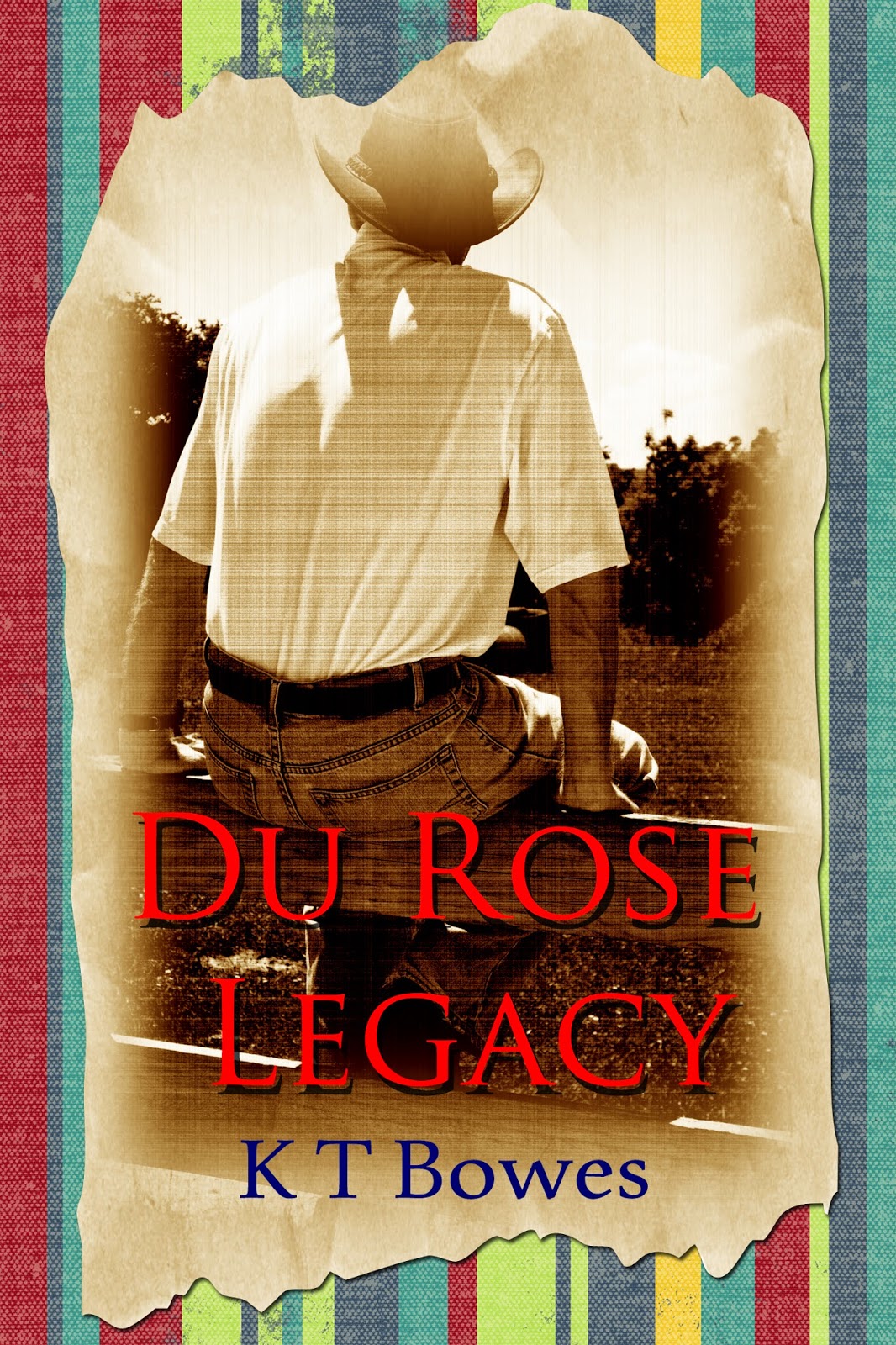
In
Du Rose Legacy, there’s a pregnancy, which means that at some point, a baby is
going to have to come out. I wrote those scenes from experience. They were an
emotional roller coaster of excitement, fear and relief, often all in the same
minute, an uncontrolled lurching from one to the other, all borrowed from my
own life.
The New Du Rose Matriarch begins with a new mother failing to cope,
running all kinds of stupid, unrealistic scenarios through her head, battered
by exhaustion and feelings of guilt and failure. Readers have emailed me to
tell me that they cried all the way through both of those scenes. They had been there and they understood. It
touched something deep inside, something raw and painful but at the same time,
reminded them that they had survived.
Perhaps
I’m too emotional, too descriptive and verbose, a reader will always be the
judge of that. I could have simply written, Hana
wasn’t coping with her crying baby... and moved on to some more interesting
plot moment, like when she finds a killer waiting for her by her car, or gets
snatched. But if I did that, why on earth would the reader care? You care about
Hana because you’ve grown to love her, with her red hair and her frustrating
thought processes which make you want to kill her yourself, preferably after
you’ve taken her out for coffee and tried to explain some salient facts to her.
Emotion
isn’t back story, but it’s being confused with it. I’m tired of reading these
two dimensional stories with lots of action and no substance. I never used to
stop reading a novel, not for anything. I’ve struggled through some real
doozies in my time. But lately, I’ve decided that I’m the wrong side of forty
to be wasting valuable hours in a dead loss. So I am being more picky and less
committed and I don’t think I’m alone. If an author isn’t willing to invest in
their own character enough to let me, the reader, know how they feel about
their circumstances or describe what they even look like, how can they expect me to
battle on through to the end with them? It becomes a one-way partnership and I’m
doing all the work.
My
favourite novel of all time is MM Kaye's, ‘The Far Pavilions’ and has been for
over twenty years. I’ve read it numerous times. It’s a massive piece of work
and even in teeny-tiny print, you couldn’t fit the thing in your handbag. It’s
easily bigger than a house brick. You could probably brain someone with it
actually, only you wouldn’t be able to stop reading it long enough. It’s a
colourful parade of the most in depth writing imaginable. The characters become like
friends and you care about them enough to stay up late reading, in the hope
that their circumstances will improve before you have to get up for work. It’s
a detailed emotional roller coaster and I love every single page of it.
Nowadays, I get the sense that it would be called ‘too wordy’, ‘not enough
action’, ‘a bit too detailed’, ‘let’s cut the emotional stuff and throw the
sister on the funeral pyre so that she can get on with committing suttee’.
As
authors, we’re competing in a world where nobody waits for anything. Every need
can be fulfilled by a phone call, the push of a button or a sharply issued
demand. Our heads are bursting with our own mess, so why on earth would we want
to climb into someone else’s head and see how they cope with life?
The
answer is: because we can.
I
want to. Do you want to?
I
want more than just to hang from the wing mirrors of a speeding car feeling
disconcerted and afraid. I want to plumb depths that my own life either has, or
will never take me into. Above all, I want to escape and I will ultimately do
that by making friends and walking a mile in their shoes.
So help me out here.
What do your characters look like and what really makes them tick?
Subscribe to:
Posts (Atom)